'%20/%3e%3cg%20opacity='1'%20transform='translate(150.5%200)%20rotate(0)'%3e%3cpath%20id='路径%204'%20fill-rule='evenodd'%20style='fill:%23C70000'%20opacity='1'%20d='M494%20472.601L487%20410.101L460%20472.601L494%20472.601Z'%3e%3c/path%3e%3cpath%20id='路径%203'%20fill-rule='evenodd'%20style='fill:%23003686'%20opacity='1'%20d='M80%20620.761C152%20676.261%20250%20670.761%20264.5%20670.761C351%20664.261%20412.5%20636.261%20443.5%20620.761C536%20572.261%20580.45%20516.261%20599.5%20492.261C566.05%20492.261%20483.5%20492.261%20465.5%20492.261C408%20532.761%20385.5%20541.761%20369%20550.261C262.5%20599.761%20214%20591.261%20184%20591.261C81%20584.761%2024.3%20510.211%200%20478.261C23%20580.261%2067.5%20609.261%2080%20620.761Z'%3e%3c/path%3e%3cpath%20id='路径%202'%20fill-rule='evenodd'%20style='fill:%23003686'%20opacity='1'%20d='M427.998%202.26C325.498%2014.26%20222.068%2073.64%20247.998%2063.76C384.498%2011.76%20427.998%2024.76%20437.998%2024.76C526.998%2041.76%20559.998%2085.76%20568.998%2095.76C606.498%20142.26%20611.398%20187.06%20613.498%20206.26C631.458%20206.26%20679.498%20206.26%20703.998%20206.26C692.998%20109.26%20633.378%2063.91%20622.998%2056.26C563.998%2012.76%20513.248%205.41%20491.498%202.26C467.498%20-2.24%20437.168%201.19%20427.998%202.26Z'%3e%3c/path%3e%3cpath%20id='路径%201'%20fill-rule='evenodd'%20style='fill:%23C70000'%20opacity='1'%20d='M232%20206.763C243%20178.763%20262%20156.763%20273.5%20140.263C329%2080.2634%20374%2069.7634%20410.5%2061.2634C446.5%2052.2634%20499%2061.2634%20504.5%2061.2634C446%2039.7634%20393%2040.7634%20387.5%2040.7634C308.5%2047.2634%20259.5%2075.2634%20237%2088.7634C162.5%20135.263%20122.95%20185.313%20106%20206.763C139.86%20206.763%20221.5%20206.763%20232%20206.763Z'%3e%3c/path%3e%3c/g%3e%3cpath%20id='减去顶层'%20fill-rule='evenodd'%20style='fill:%23003686'%20opacity='1'%20d='M379.519,227.698l4.237,4.101l-38.576,198.188h98.804l3.966,3.839l-7.614,38.817h-147.091l-4.064,-3.934l46.975,-241.011zM900.883,363.706c-21,-8.75%20-34.89067,-17.22667%20-41.672,-25.43c-6.78133,-8.20333%20-10.172,-19.19533%20-10.172,-32.976c0,-24.06267%208.832,-43.75033%2026.496,-59.063c17.664,-15.312%2040.55067,-22.968%2068.66,-22.968c11.266,0%2022.231,1.121%2032.895,3.363c10.664,2.242%2020.974,5.60533%2030.93,10.09l-8.139,40.672l-5.05,2.827c-6.54467,-5.18467%20-13.96233,-9.21167%20-22.253,-12.081c-9.95333,-3.44533%20-21.00033,-5.168%20-33.141,-5.168c-12.906,0%20-23.406,3.08967%20-31.5,9.269c-8.09333,6.18%20-12.14,14.08233%20-12.14,23.707c0,9.18733%2010.06233,18.32%2030.187,27.398l1.149,0.493l19.031,8.367c15.96867,7.10933%2027.64433,15.668%2035.027,25.676c7.38267,10.00733%2011.074,22.28467%2011.074,36.832c0,25.156%20-8.80467,45.226%20-26.414,60.21c-17.60933,14.98467%20-41.39833,22.477%20-71.367,22.477c-12.03133,0%20-24.30867,-1.422%20-36.832,-4.266c-12.52333,-2.84333%20-25.56633,-7.16367%20-39.129,-12.961l8.62,-44.559l4.63,-2.592c9.52333,7.45333%2019.435,13.24467%2029.735,17.374c11.59333,4.64867%2023.24167,6.973%2034.945,6.973c14.54667,0%2025.97633,-3.19933%2034.289,-9.598c8.31267,-6.39867%2012.469,-15.06667%2012.469,-26.004c0,-6.78133%20-1.914,-12.66%20-5.742,-17.636c-3.82867,-4.97667%20-9.51633,-9.051%20-17.063,-12.223zM54.3672,227.698h68.9058c25.81267,0%2045.473,5.004%2058.981,15.012c13.50733,10.008%2020.261,24.58233%2020.261,43.723c0,12.46867%20-1.996,24.82767%20-5.988,37.077c-3.992,12.25%20-9.16,21.98467%20-15.504,29.204c-8.53133,9.95267%20-19.14067,17.14433%20-31.828,21.575c-12.68733,4.42867%20-29.14817,6.643%20-49.3825,6.643h-26.9063l-17.8828,91.711h-43.7778l-3.88732,-3.761zM642.062,227.698h59.063l18.238,240.969l-4.109,3.976h-43.66l-2.297,-60.539h-0.041l-1.756,-40.844l-0.04,-0.002l-3.249,-98.607l-41.151,94.615l-0.06,-0.006l-20.5,47.5h0.005l-25.411,57.883h-43.849l-3.589,-3.474zM94.7266,268.386l-13.7813,71.859h23.4607c15.96867,0%2027.918,-3.69133%2035.848,-11.074c7.92933,-7.38267%2011.894,-18.457%2011.894,-33.223c0,-9.95333%20-2.84367,-17.03533%20-8.531,-21.246c-5.68733,-4.21067%20-15.367,-6.316%20-29.039,-6.316z'%3e%3c/path%3e%3c/svg%3e)

December 15, 2025 – BASF's management and employee representatives have signed a new plant agreement titled "Shaping the Future, Building a Strong Production Site Together." This five-year agreement will initially apply to employees at BASF's Ludwigshafen site for the first three years (from January 1, 2026, to December 31, 2028). It will automatically be extended for another two years if agreed-upon targets for restoring profitability are met.
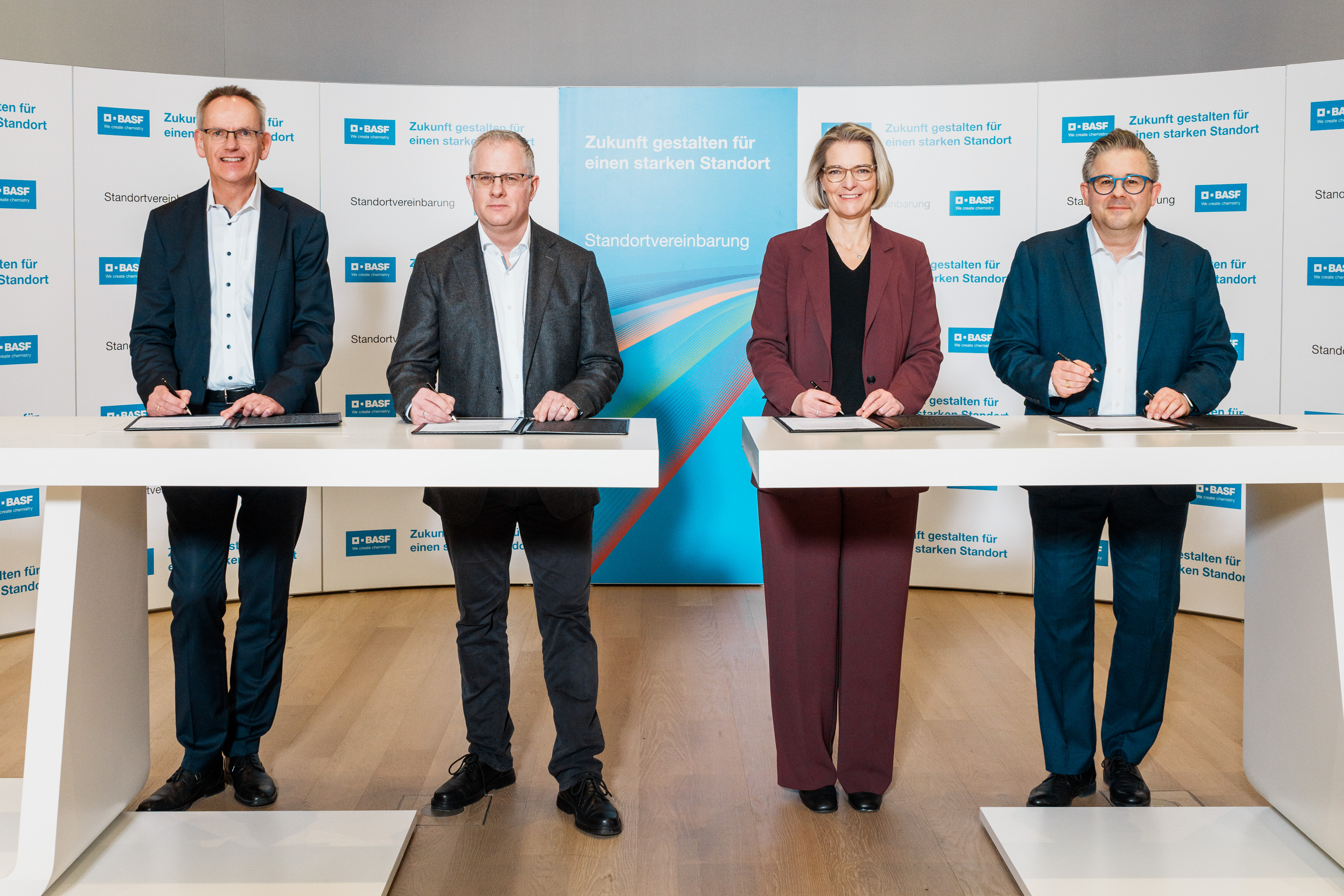
This new plant agreement aims to address the current challenges facing the chemical industry. Against a backdrop of challenging economic and geopolitical conditions, the agreement focuses on enhancing the competitiveness and adaptability of the Ludwigshafen site. It lays the groundwork for structural transformation, safeguards employees from forced layoffs, and sends a strong signal encouraging investment and partnerships. As BASF's largest integrated production site, the Ludwigshafen site is crucial to the company's long-term success.
Core Agreement Contents:
Job Security: BASF commits to implementing no forced layoffs for the duration of the agreement.
Continued Investment: BASF will continue investing in the Ludwigshafen Verbund site, aiming to establish it as a leading sustainable chemical site in Europe. Planned investments are approximately €2 billion per year (at least €1.5 billion) for modernizing and expanding infrastructure and capacity, as well as for the site's sustainable transformation.
Transformation & Flexibility: The sustainable transformation and safeguarding of the site's competitiveness will bring changes for all employees. This includes streamlining organizational structures, increasing flexibility, continuously enhancing productivity through digitalization and artificial intelligence, and maintaining a consistent focus on sustainable cost optimization.
Modernized Working Time Management: To further enhance operational efficiency and optimize the employee experience, the company will upgrade its working time management system and introduce digital tools to support personnel scheduling.
Performance Enhancement & Development: The agreement is dedicated to fostering a performance culture, with special attention to employee qualification and continuous development. By integrating learning into daily work routines, adopting modern learning formats, and providing targeted qualification training, the agreement aims to secure employees' professional competitiveness and team innovation vitality. This framework not only strengthens individual capability building but also lays a talent foundation for the company's long-term adaptability and technological innovation.
Health & Quality of Life: BASF is committed to building a comprehensive employee well-being system. By investing in health programs, promoting personalized preventive healthcare, and providing mental health support, the company aims to comprehensively improve employees' physical and mental health. Simultaneously, BASF is actively developing sustainable mobility solutions, including expanding electric vehicle charging infrastructure and encouraging the use of public transport, to reduce its environmental footprint and promote low-carbon commuting. Furthermore, BASF continues to fulfill its corporate social responsibility by promoting educational equity, equal opportunity, and social cohesion in the Rhine-Neckar Metropolitan Region.
Transparent Communication Mechanisms: The agreement sets clear framework conditions for implementing the transformation and establishes regular review mechanisms to ensure effective implementation. Management and the Works Council have committed to engaging in ongoing, solution-oriented dialogue.
Katja Scharpwinkel, member of the BASF Board of Executive Directors and Labor Director, stated: "The new plant agreement is the result of constructive negotiations between management and employee representatives. It provides security for necessary changes and flexibility, and helps the Ludwigshafen site regain its competitiveness. At the same time, it provides clear guidance in an environment full of change. The guarantee of no forced layoffs for at least three years provides us with the security we need to implement transformation projects. We will continue to invest in the Ludwigshafen site – this shows that the site has a promising future, and our employees, with their expertise and experience, are making a crucial contribution."
Sinischa Horvat, Chairperson of the BASF Works Council, said: "The tough negotiations were worth it: the core of the Ludwigshafen site – including production, research and development, marketing, specialist departments, infrastructure, and services – has been secured through concrete investment commitments, and employees are protected from forced layoffs for the term of the agreement. Given the persistent structural and economic challenges, this outcome was not easily achieved. But ultimately, it demonstrates our clear commitment to the site and our employees, and it shows our shared confidence in jointly steering BASF back onto a path of success. At the start of 2026, we will be able to focus once again on tackling the major structural challenges we need to solve."